

The villa journal
A Villa Budget Needs Three Separate Totals
Keep purchase and setup costs, recurring bills and planned reserves visible. A worked example shows how a neat monthly figure can hide an incomplete budget.
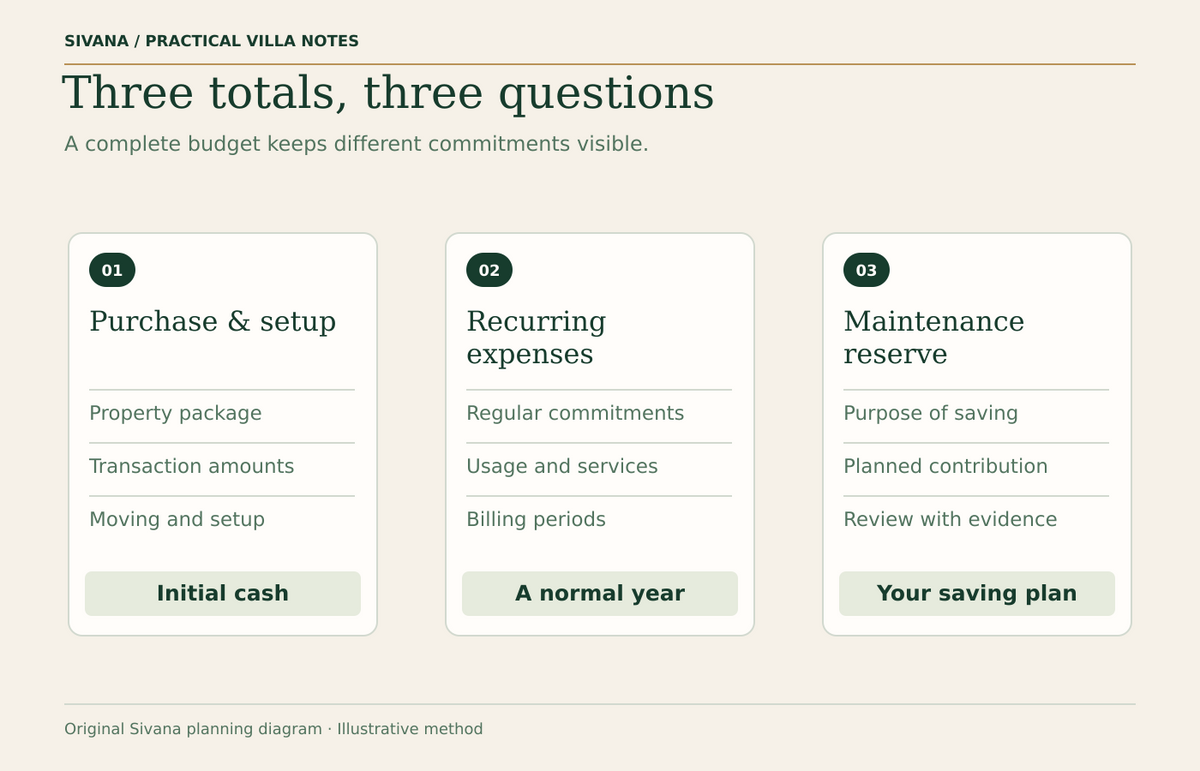
A single monthly figure is convenient to remember, but it rarely explains an entire villa budget. The cost of getting into the home, the bills for running it and the money set aside for future work answer different questions. Keeping three totals visible makes the calculation easier to check and the purchase easier to plan.
First, establish the purchase and setup total
Begin with the agreed property price and a separate schedule for other amounts payable around the transaction. Ask your professional advisers to confirm the charges and responsibilities relevant to the exact purchase. Add the moving, furnishing or immediate work that your own plans require. Record the expected payment stage alongside each amount.
This is a cash planning exercise. Two items with the same value can create different pressures if one is payable immediately and the other several months later. A useful row therefore contains the description, amount, basis, person responsible and expected timing. Where a charge remains uncertain, record the question instead of entering a reassuring zero.
Next, calculate a normal year of recurring expenses
List estate charges, utilities, internet, insurance and the private services you expect to use. Establish whether each quote is monthly, annual, per visit or based on usage. Convert the figures to one period before adding them. Keep the original unit in your notes so you can check the conversion later.
Consider this fictional arithmetic example. An owner enters THB 4,000 a month for one fixed service and THB 2,000 a month for another. Together they produce THB 72,000 a year. If an annual bill of THB 12,000 is also expected, the recurring total becomes THB 84,000. These figures are invented to demonstrate the calculation; they are not Sivana fees or local quotations.
Now imagine electricity, pool care and insurance have not been entered. THB 84,000 is still mathematically correct for the completed rows, but it is not a complete cost of ownership. The list of omissions is as important as the subtotal.
Give the reserve its own line
A reserve is money you plan to set aside for irregular expenditure. It might relate to equipment replacement, decorating or other future work. Decide its basis using the equipment in the home, available service information and your own financial planning. Do not label an arbitrary percentage as a verified maintenance cost.
If you choose to save THB 1,500 monthly in a fictional example, that adds THB 18,000 to annual planned contributions. A contribution is not proof that repairs will cost that amount, and it is not necessarily a charge payable to a developer. Showing it separately prevents the budget from confusing household savings with invoices.
Check where documented estate charges belong
The existing Sivana Hills running cost guide distinguishes recurring common area management from the separately documented sinking fund and meter deposit. That distinction is useful when building a budget. Use the exact plot information and obtain current written confirmation of the terms relevant to your purchase.
Do not assume that a management charge covers every private service. For each proposed line, ask what is included, what is excluded and whether another budget entry already covers it. This catches both missing costs and double counting.
Make the next conversation specific
Complete the ownership budget planner with the figures you can support today. Then export the working and highlight the unresolved rows. “Please confirm the private pool service scope and price for this plot” is a clearer request than “What does everything cost?” Keep the source and unit attached to each answer as it arrives.
The finished budget should let you see the initial cash requirement, the recurring year and your planned reserve without having to untangle them again. See sources and methods for the reference documents and calculation approach.